The purpose of this blog is to highlight the relationships between the military and our advanced chemistry curriculum. Our curriculum covers 6 main topics: Liquids/solids, Solutions, Thermochemistry, Kinetics, Electrochemistry, and Organic Chemistry. Each of the 4 members in our group will contribute blog posts, which will emphasize the important chemical aspects of the military-related subject. Enjoy!

Thursday, November 15, 2012

War Paint with a Twist


Every year, the explosions of over 16,000 IEDs (Improvised Explosive Devices) kill and wound US and NATO military service men and women deployed in Iraq and Afghanistan. The number of IEDs is from a count done in 2011, and that count is only expected to rise in this year and the next. As of 1 October 2012, more than 50 soldiers had been killed by shrapnel and IED explosions.

The problem with IEDs is that they are buried, and when riding in a bumping and shaking vehicle, they are almost impossible to detect. In recent months, soldiers have been getting training in the detection and defusing of the bombs. IEDs do not just create shrapnel, they also create a huge amount of heat—more than 1000 degrees Fahrenheit--when the explosives detonate.  This heat can do catastrophic damage to any exposed body parts, cook skin, and even set clothing on fire. Soldiers have received burns that can only be called gruesome, and for that reason, no further detail will be given.

Presented at a meeting of the American Chemical Society, a new paint has been designed to combat this problem. It would be applied to soldier’s faces, and would shield them from the extreme temperatures created in a bomb blast. The Army has used face paint before, but it has been made with hydrocarbom compounds, which burn easily and can amplify the effect of the massive temperature increase.  The Army also requires that the paint contain 35% DEET, another flammable substance that is used to keep bugs away.  The new paint, while still incorporating the DEET, uses less flammable silicon compounds, and uses a hydrogel around it. The hydrogel is made up of mostly water. An IED explosion’s heat lasts for around 2 seconds, but this new paint has been tested to last for up to 15 seconds. This is a big step forward in protecting our troops, and when combined with the D30 from below, many families won’t have to receive that dreaded visit from the two uniformed service members.                                      


Newly-developed face paint that shields soldiers' faces from high temperatures.


By: Jake Roth

Tuesday, October 16, 2012

D3O: The Best Body Armor


D3O is a dilatant non-Newtonian fluid commonly used for impact protection. In its raw state, the compound flows freely when moved slowly. But at the instance of a sudden physical occurrence, it locks together to absorb and disperse energy, and immediately returns back to its flexible state. When it is introduced to any form of impact the offshoots lock together and become hard within a 1,000th of a second to absorb and spread the force, significantly reducing the effect of impact. It is able to withstand about 100 or so direct impacts at full force before degrading.

This transformation is possible due to the way the molecules move with each other. When the material is being moved at low speeds it is soft and flexible, because the bonds between the molecules are not strong, so they can slip past each other. When the material is moved quickly by a sudden force, the molecules re-arrange themselves in a very structured way and create proper hydrogen bonds. When you impact the molecules they do not have time to move and they quickly lock into position.


An illustration of how D3O, a non-Newtonian fluid, works upon impact.

A Newtonian fluid (named after Sir Isaac Newton) is a fluid whose stress versus strain rate curve is linear and passes through the origin. The constant of proportionality is known as the viscosity. A non-Newtonian fluid is a fluid whose viscosity is variable based on applied stress. The most commonly known non-Newtonian fluid is cornstarch dissolved in water.

Dr. Richard Palmer and a group of hired scientists began to develop a polymer that held the same name as the company, D3O. They sought out to manufacture a high-performance shock absorption material that had high-flexibility and maintained a good comfort level. As you can see, D3O is very apt in military situations such as land battles, where bullets and who knows what kind of shrapnel will fly at your body!

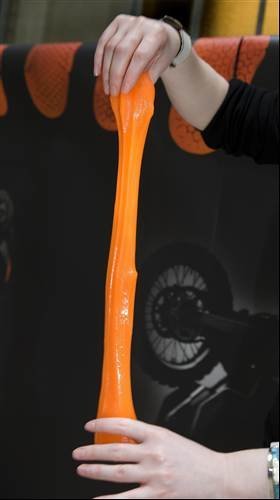
D3O is a very stretchy solid  that is
 hard to rip apart or pierce through. 
 D3O incorporated into military body armor.


By: Max Lauring, Jeff Bulick, Brandon Oviedo, and Jake Roth